📖 What's in This Guide
⭐ KEY FACT: 1964 Nickels Contain NO Silver
Despite being struck in the last year of 90% silver dimes, quarters, and half dollars, the 1964 Jefferson nickel is composed entirely of 75% copper and 25% nickel — no precious metals. Its value is driven entirely by condition, Full Steps designation, variety, and errors. The melt value is essentially zero for collecting purposes.
How to Identify a 1964 Jefferson Nickel:
- ✓ Thomas Jefferson portrait facing left on obverse — designed by Felix Schlag in 1938 based on Houdon's famous bust
- ✓ Monticello on the reverse — Jefferson's Virginia estate, with architectural steps at the base
- ✓ Mint mark location: reverse side, to the right of Monticello — no mark = Philadelphia, D = Denver
- ✓ 1964 was the LAST year mint marks appeared on the nickel reverse — moved to obverse (below date) starting 1968
- ✓ Composition: 75% copper + 25% nickel — no silver content
- ✓ Weight: 5.0 grams · Diameter: 21.2mm · Plain (smooth) edge
- ✓ Full Steps (FS): 5 or 6 clearly defined steps at Monticello's base = major premium designation
Designer's initials “FS” (Felix Schlag) appear on the obverse below Jefferson's portrait. The Jefferson Nickel series began in 1938 and remains in production today — making it the longest-running U.S. nickel design.
The 1964 Jefferson nickel is simultaneously one of the most common and most misunderstood coins in American numismatics. With over 2 billion struck across Philadelphia and Denver — many dated 1964 but actually minted in 1965 and 1966 due to the government's coin-shortage “date freeze” — the overwhelming majority are worth exactly five cents. But within that sea of ordinary nickels are Full Steps coins worth thousands, a Special Mint Set specimen that sold for $32,900, a D/D Repunched Mintmark that brought $19,800, and a catalog of striking errors that attract serious collector interest.
The Greysheet price guide for the 1964 Jefferson Nickel tracks current dealer buy and sell prices across all grades and varieties — from a common circulated example worth a nickel to rare Full Steps specimens commanding four and five figures. Understanding where your 1964 nickel falls on that spectrum starts with one simple question: can you see the steps?
“The 1964 Jefferson nickel is the ultimate example of a coin where appearance is everything. Two billion exist — but the ones with clear, complete steps on Monticello are genuinely rare. The difference between a flat strike and a Full Steps coin can be the difference between face value and $14,000.”
The 30-Second 1964 Nickel Quick Check
Before you spend it — or get excited
The Traffic Light System
Red = Worth face value (5 cents)
Circulated 1964-P or 1964-D, flat steps on Monticello — billions minted, no premium
Yellow = Worth investigating ($1–$100)
Uncirculated MS63–MS65, proof, partial steps, minor error (die crack, small clip)
Green = Jackpot potential ($200–$32,900)
Full Steps MS66+, D/D RPM FS-501, SMS specimen, strong DDO, or wrong planchet — do NOT spend
Table 1: 1964 Jefferson Nickel — First Glance Value Indicators
| What to Look For | Where to Find It | What It Means | Value Range |
|---|---|---|---|
| Flat, worn steps on Monticello | Reverse, base of building | Circulated or weak strike — face value | $0.05 |
| No mint mark (reverse) | Right of Monticello | Philadelphia — common | $0.05–$14,100 |
| D mint mark (reverse) | Right of Monticello | Denver — check for RPM under loupe | $0.05–$19,800 |
| 5 or 6 clear steps visible | Monticello base, reverse | Full Steps (5FS or 6FS) — key premium | $65–$14,100+ |
| Mirror-like proof surfaces | Entire coin | Proof — collector strike from Philadelphia | $5–$2,750+ |
| Satin/frosty surfaces, sharp details | Entire coin | SMS (Special Mint Set) — extremely rare | $1,000–$32,900 |
| Doubled D mintmark under loupe | Right of Monticello, magnified | D/D RPM FS-501 — most valuable variety | $500–$19,800 |
| Wrong weight (not 5.0g) ⭐ | Scale: 5.0g = normal | Wrong planchet error — rare | $300–$10,000+ |
👉 Reality Check:
Over 2 billion 1964 Jefferson nickels exist, making the circulated majority worth exactly 5 cents. The key differentiators are: (1) Full Steps on Monticello — check under magnification; (2) the D/D Repunched Mintmark on 1964-D — requires a loupe; (3) a potential SMS specimen — identified by unusually sharp, satin-finish detail across all design elements.
All 1964 Nickel Varieties: P, D, Proof, SMS & Full Steps
Six distinct collecting categories — dramatically different values
The 1964 Jefferson nickel appears uniform at first glance — same green-gray color, same Monticello reverse, same 21.2mm diameter. But six distinct collecting categories exist, each with very different values. Philadelphia and Denver produced circulation strikes by the billions. San Francisco struck proofs for collector sets. And somewhere in that production, a small number of Special Mint Set (SMS) specimens were struck with a distinctive satin finish that separates them entirely from the ordinary coin.
Table 2: All 1964 Jefferson Nickel Varieties at a Glance
| Variety | Mint | Mintage | Key Feature | Value Range |
|---|---|---|---|---|
| 1964-P (No Mint Mark) | Philadelphia | 1,024,672,000 | Reverse: no mint mark right of Monticello | $0.05–$14,100 (MS67FS) |
| 1964-D | Denver | 1,787,297,160 | “D” right of Monticello — check for D/D RPM | $0.05–$19,800 (D/D RPM) |
| 1964 Proof | Philadelphia | 3,950,762 | Mirror-like finish, struck for collector sets | $5–$2,750 (PR67+) |
| 1964 SMS ⭐ | Philadelphia | Extremely rare | Satin/frosty finish, razor-sharp details | $1,000–$32,900 |
| Any + Full Steps (5FS/6FS) ⭐ | P or D | Small fraction of any mintage | 5 or 6 complete steps at Monticello base | $65–$14,100 |
| 1964-D D/D RPM FS-501 ⭐ | Denver | Very scarce | Doubled “D” mintmark, offset impression | $500–$19,800 (MS66) |
⭐ The Date Freeze — Why So Many 1964 Nickels Exist
In 1964, America faced a severe coin shortage driven by silver speculation and hoarding. To combat this, the U.S. Treasury ordered mints to continue striking coins dated 1964 well into 1965 and 1966 — a policy called the “date freeze.” The result: over 2 billion 1964-dated Jefferson nickels were produced over a three-year span, making this the highest single-year mintage in nickel history. The extended production also created more opportunities for die varieties and errors, which is why the 1964-D D/D RPM is so well-documented.
1964 Jefferson Nickel Value by Grade and Variety
Current retail values — 2026 market data
Table 3: 1964 Nickel Value — Circulated & Low Mint State
| Variety | Circulated | MS60–MS63 | MS64–MS65 | MS65 Full Steps |
|---|---|---|---|---|
| 1964-P (No Mint Mark) | $0.05 | $0.25–$1 | $3–$15 | $65–$200 |
| 1964-D | $0.05 | $0.25–$1 | $3–$15 | $65–$200 |
| 1964 Proof | — | $5–$8 | $8–$20 | Proof FS rare, $100+ |
| 1964-D D/D RPM FS-501 ⭐ | $20–$50 | $100–$300 | $500–$2,000 | MS65+ $9,000; MS66 $19,800 |
Table 4: 1964 Nickel — High Grade MS66+ Values
| Variety | MS66 | MS67 | MS67 Full Steps | Top Auction |
|---|---|---|---|---|
| 1964-P (No FS) | $30–$80 | $200–$500 | $5,000+ | $14,100 (MS67FS, 2014) |
| 1964-D (No FS) | $30–$80 | $200–$500 | $5,000+ | Similar to P |
| 1964 Proof (PR67) | $500+ | $1,000+ | PR67 ~$2,750 | $2,750 (PR67 DCAM) |
| 1964-D D/D RPM MS66 ⭐ | $19,800 | Extremely rare | N/A | $19,800 (MS66) |
| 1964 SMS SP67FS / SP68FS ⭐ | SP67FS $22,800 | N/A | N/A | $32,900 (SMS SP68FS) |
How to Identify Full Steps on the 1964 Jefferson Nickel
The designation that turns a 5-cent coin into a $14,000 coin
The Full Steps (FS) designation is the single most important factor in 1964 Jefferson nickel collecting. Monticello's distinctive front staircase has either five or six steps visible in the original design — but due to the mass production methods and worn dies of 1964, the vast majority of 1964 nickels show flattened, indistinct steps that blur together. A coin with sharply defined, separated steps from top to bottom of the staircase earns the Full Steps designation from NGC (5FS or 6FS) or PCGS (FS), and commands premiums that can be 100 times or more than the same grade without Full Steps.
Full Steps vs No Full Steps — What to Look For
🔍 No Full Steps — COMMON
- • Steps appear flat, merged, or blurry at Monticello's base
- • Cannot count 5 or 6 distinct separated steps
- • Most 1964 nickels — produced on worn dies under time pressure
- • Value: face value to ~$500 even in MS67
⭐ Full Steps (5FS or 6FS) — PREMIUM
- • 5 or 6 sharply defined, separated steps clearly visible
- • Sharp horizontal lines between each step, no merging
- • Produced from fresh dies with proper striking pressure
- • Value: $65 (MS64FS) to $14,100+ (MS67FS)
- • 6FS is rarer and more valuable than 5FS
Identification tip: Use 5×–10× magnification and focus on the base of Monticello. Count the steps from left to right — each step must show a distinct horizontal line separating it from the next. If the lines blur or merge anywhere along the staircase, it does not qualify for Full Steps designation. PCGS and NGC certification is required for market recognition of FS coins above $500.
1964 Jefferson Nickel Error List with Pictures
Ten documented error types — values, identification tips, and images
The 1964 Jefferson nickel produced a well-documented roster of minting errors, ranging from common die cracks worth a few dollars to wrong planchet errors worth thousands. The extended “date freeze” production run — spanning 1964–1966 on worn dies — created ideal conditions for die varieties, repunched mintmarks, and striking errors to slip through quality control. For the definitive 1964 nickel value on a potential error coin, professional authentication by PCGS or NGC is recommended for coins worth $200 or more.
Table 5: 1964 Jefferson Nickel — Error Coins Summary
| # | Error Type | Rarity | Value Range |
|---|---|---|---|
| 1 | Doubled Die Obverse (DDO) | Rare | $50–$500+ |
| 2 | Doubled Die Reverse (DDR) | Rare | $30–$300 |
| 3 | Off-Center Strike | Scarce | $20–$400+ |
| 4 | Die Crack / Retained Cud | Uncommon | $2–$100 |
| 5 | Broadstrike (No Collar) | Scarce | $25–$150 |
| 6 | Clipped Planchet | Uncommon | $15–$125 |
| 7 | Struck Through / Filled Die | Uncommon | $10–$200 |
| 8 | Repunched Mintmark (D/D RPM) | Scarce–Rare (FS-501) | $5–$19,800 |
| 9 | Lamination Error | Uncommon | $8–$100 |
| 10 | Weak Strike | Common | $3–$40 |
Error #1 — Doubled Die Obverse (DDO)
Doubling on LIBERTY, the date, or Jefferson's portrait
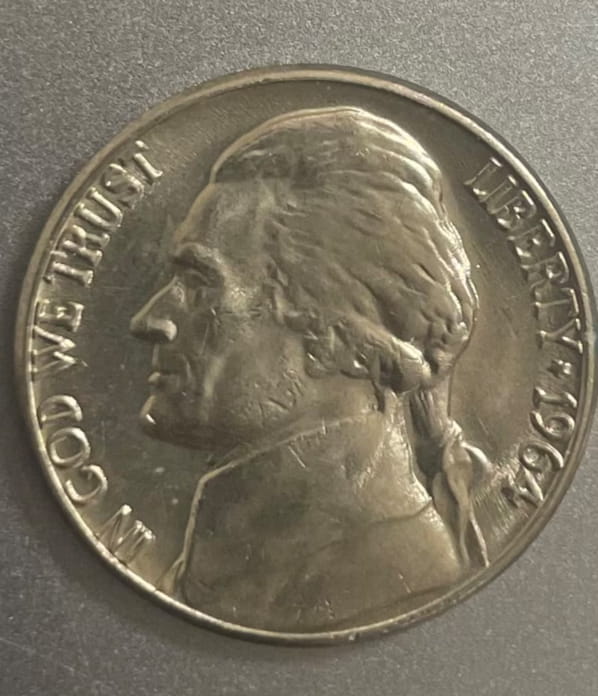
1964 Jefferson nickel DDO — visible doubling on LIBERTY, IN GOD WE TRUST, or the date “1964” under magnification.
The DDO error occurs when the die is hubbed multiple times in slightly different positions during manufacturing. The most dramatic examples show strong doubling on “LIBERTY,” “IN GOD WE TRUST,” and the date “1964.” Both Philadelphia and Denver produced DDO varieties in 1964, and proof DDO coins are particularly sought after. Strong doubling visible to the naked eye commands the highest premiums.
How to Identify:
Use 5×–10× magnification on the lettering. Look for clear separation between doubled letters — not a shelf-like extension (mechanical doubling, worthless) but a distinct second raised image. Check the date for vertical or horizontal doubling, especially the “4.” Jefferson's eye, hairline, and facial details may also show doubling on strong varieties.
Error #2 — Doubled Die Reverse (DDR)
Doubling on MONTICELLO, FIVE CENTS, or building details — 1964-D varieties especially documented
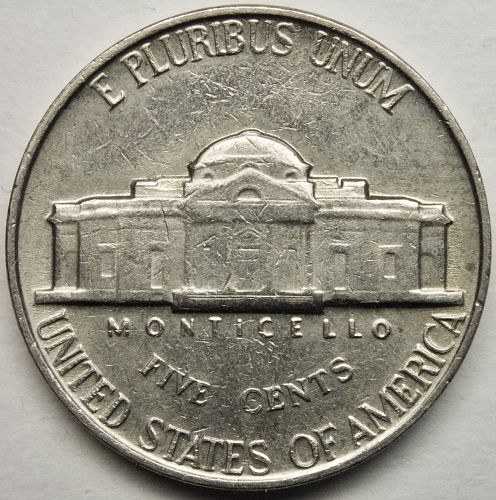
1964 Jefferson nickel DDR — doubling on MONTICELLO, FIVE CENTS, or architectural columns of the building under magnification.
The DDR error displays doubling on the reverse, most commonly visible on “MONTICELLO,” “FIVE CENTS,” and “UNITED STATES OF AMERICA.” The columns of Monticello and the building's architectural details can also show doubling effects. The 1964-D is particularly known for strong DDR varieties. Reverse doubling is generally less dramatic than obverse but can still command significant premiums on strong examples.
How to Identify:
Examine the building's architectural details and surrounding lettering for doubled lines. Check “E PLURIBUS UNUM” above Monticello and “FIVE CENTS” below for separation between doubled elements. Look at the columns of Monticello for doubled vertical lines, which are the most dramatic DDR feature.
Error #3 — Off-Center Strike
Design shifted, blank crescent area — date visibility critical for value
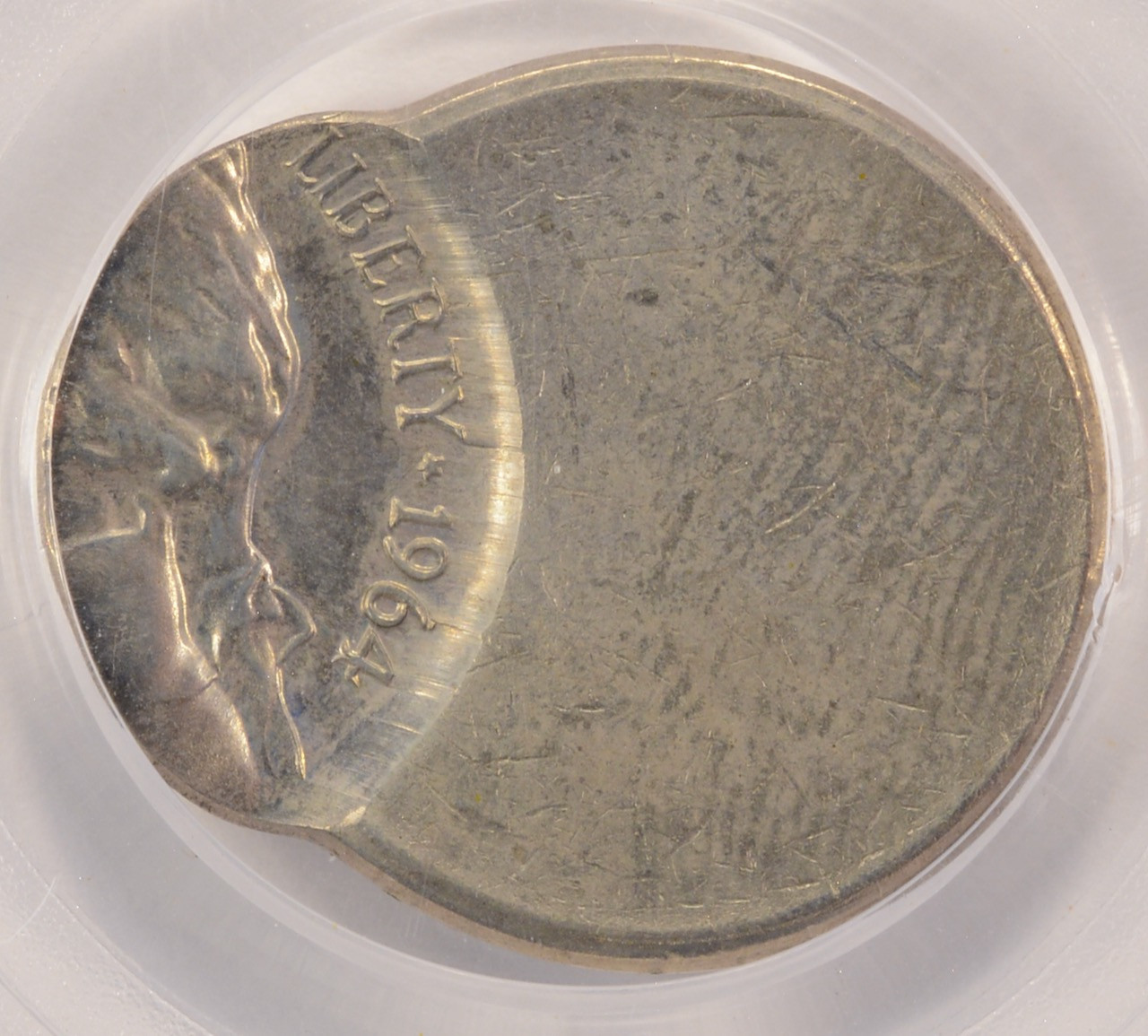
1964 Jefferson nickel off-center strike — crescent-shaped unstruck blank area, design shifted significantly from center.
Off-center strikes occur when the planchet is not properly centered between the dies, producing a coin with a crescent-shaped blank area and a design shifted to one side. The date must remain visible for the coin to be identifiable and fully collectible. Value scales sharply with percentage: 10–20% off-center = $20–$75; 25–40% = $75–$150; 50%+ with visible date = $150–$400+.
How to Identify:
The unstruck area shows a smooth, flat planchet surface with no design elements. The rim will only be raised on the struck portion. Measure the percentage of misalignment and confirm the date “1964” remains visible — both factors directly determine auction value. Dramatic 50%+ examples with the full date command the highest premiums.
Error #4 — Die Crack / Retained Cud
Raised lines from fatigue cracks in the striking die
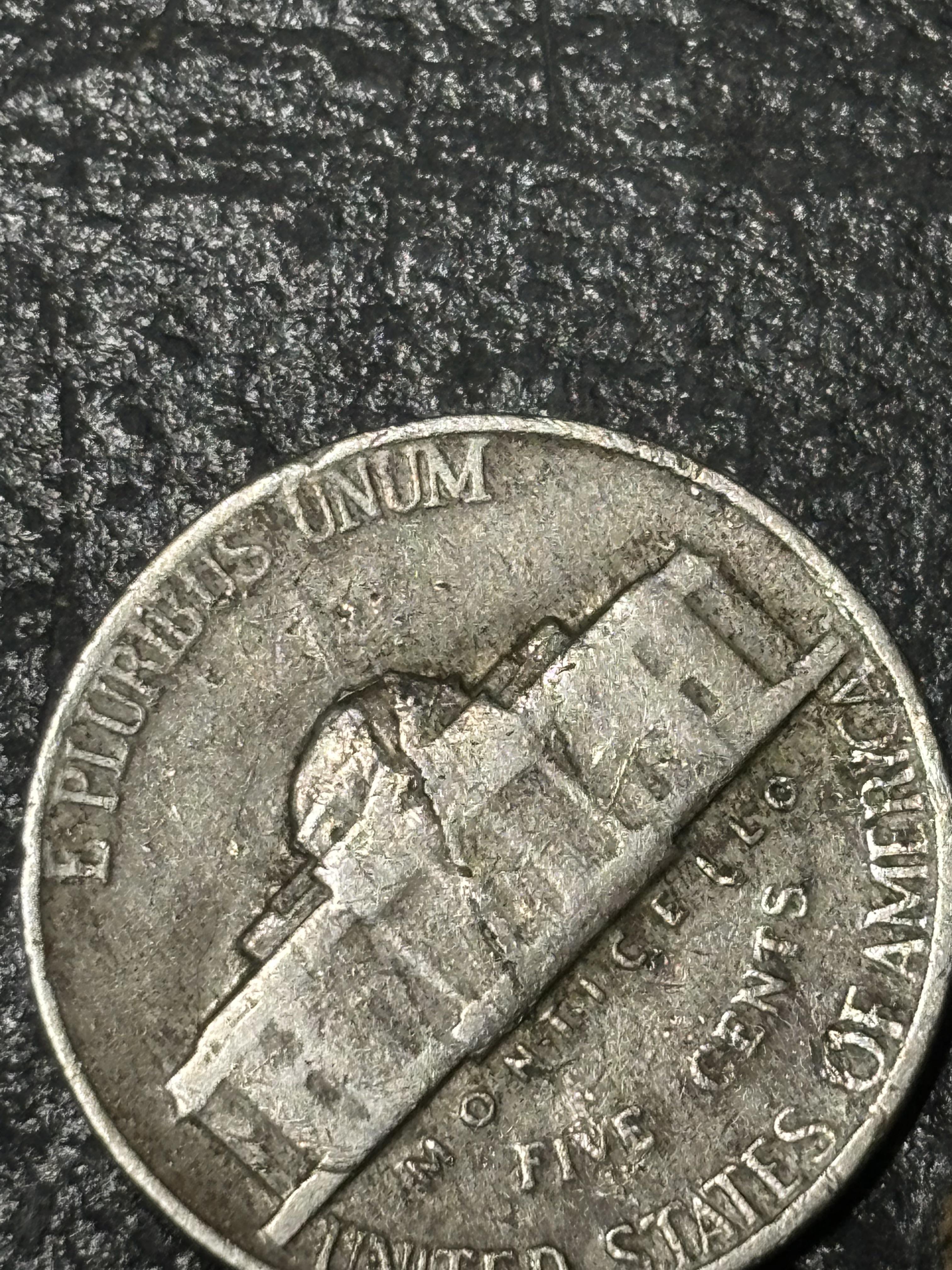
1964 Jefferson nickel die crack — raised line visible on the coin surface from a crack in the die; retained cud if a section has fully broken away.
Die cracks appear as raised lines on the coin surface, created when the die develops fractures from metal fatigue during the extended 1964 production run. Minor hairline cracks add $2–$10; major cracks through the date or lettering bring $15–$50; retained cuds (where a piece of die has broken away, leaving a blank raised blob at the rim) can reach $50–$100. Die cracks through important design features are most valuable.
How to Identify:
Die cracks are always raised above the coin surface — run a fingernail over the suspected crack. If raised, it's a die crack; if incised (sunken), it's a scratch with no premium value. Cracks often run from rim to rim or connect design elements. Cuds appear as smooth, raised blobs at the coin's rim where the die has fractured.
Error #5 — Broadstrike (No Collar)
Struck outside the retaining collar — larger diameter, no rim
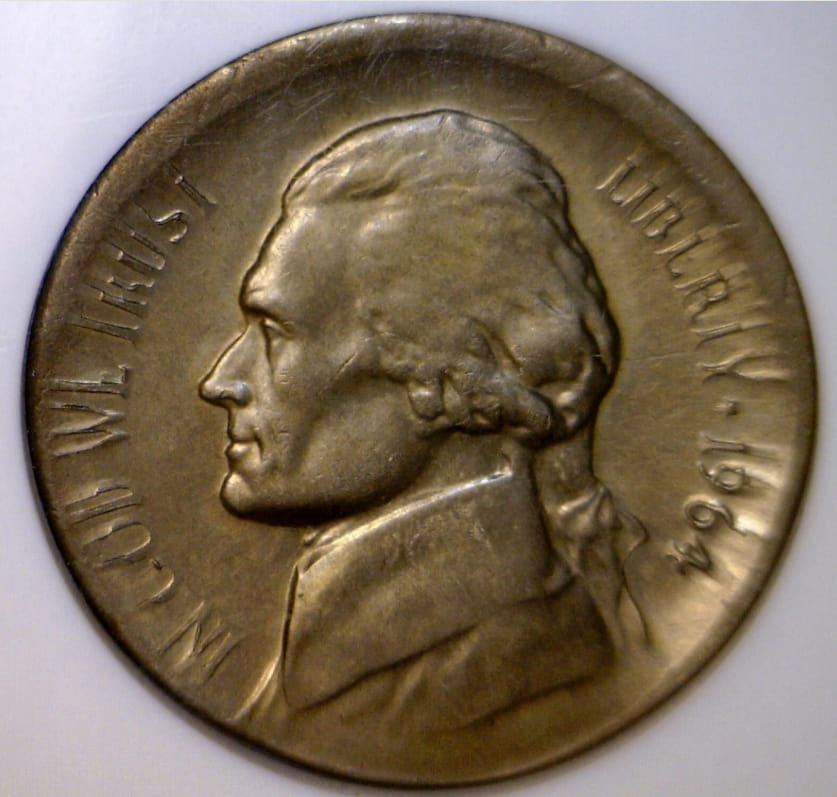
1964 Jefferson nickel broadstrike — coin is larger than normal 21.2mm, lacks a raised rim, and design appears slightly spread.
Broadstruck nickels were struck outside the retaining collar that normally limits the coin to 21.2mm and forms its smooth edge. Without the collar's constraint, metal spreads outward under striking pressure, producing a coin that exceeds the normal diameter, lacks a raised rim, and shows a slightly flattened, spread design. Complete broadstrikes with full design visible are more valuable than partial examples.
How to Identify:
Measure the diameter with calipers — a broadstruck nickel will noticeably exceed 21.2mm. The edge should be smooth and flat rather than showing a proper rim. The design elements will appear slightly spread. The coin should also appear thinner than normal due to metal spreading outward.
Error #6 — Clipped Planchet
Missing section from the blanking process — curved or straight clip
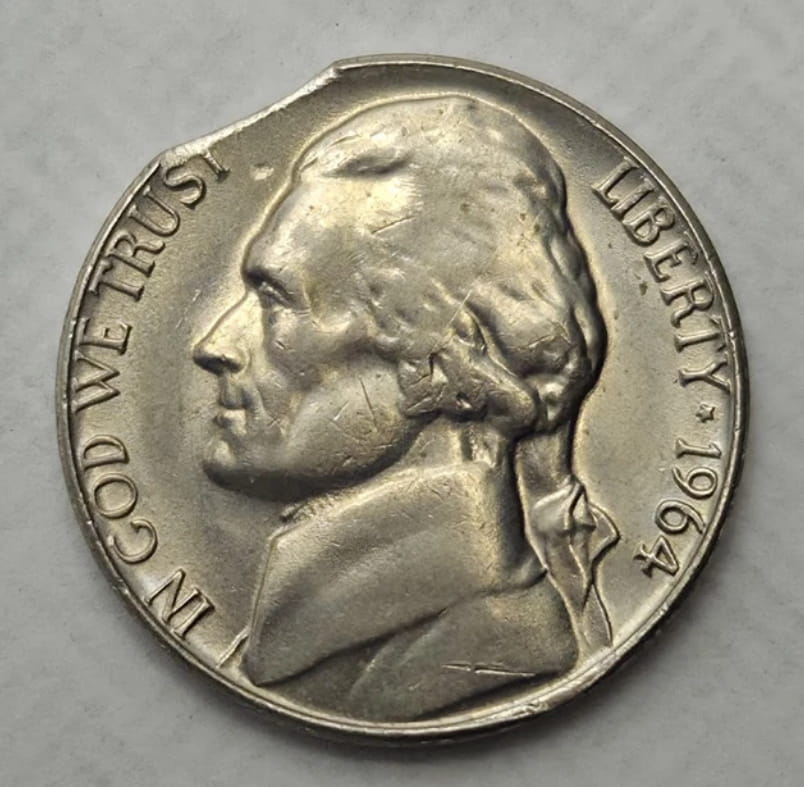
1964 Jefferson nickel clipped planchet — arc-shaped section missing from the edge, rim weakens toward the clipped area.
Clipped planchet errors occur when the blanking machine overlaps previous cuts, creating nickel blanks with missing sections. Straight clips (5–10%) are worth $15–$40; curved clips (10–20%) bring $40–$75; multiple clips can reach $75–$125. The rim characteristically weakens or disappears near the clipped area — a diagnostic feature distinguishing genuine mint clips from post-strike damage.
How to Identify:
Genuine clips show smooth, rounded edges at the missing section — not sharp, jagged breaks. The rim will fade and weaken approaching the clip. The design should extend naturally to the edge of the clip, proving the planchet was struck on an already-defective blank. Post-mint damage shows irregular, sharp edges with no rim weakness pattern.
Error #7 — Struck Through / Filled Die
Foreign material between die and planchet — missing or textured design areas
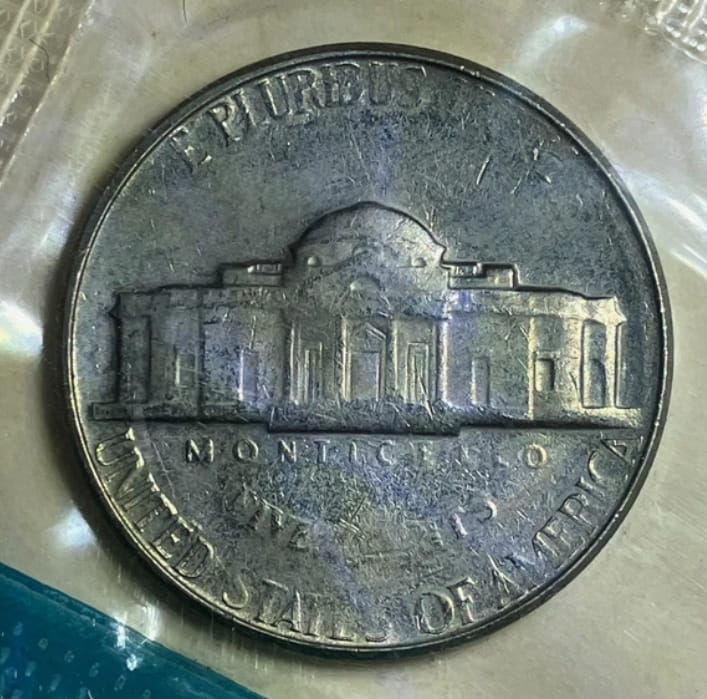
1964 Jefferson nickel struck through — area of design is flat, smooth, or shows the impressed texture of obstructing material (grease, cloth, wire).
Struck through errors occur when grease, cloth fibers, wire, or other debris is trapped between the die and planchet during striking. Grease-filled die errors ($10–$30) show smooth, flat areas where detail should appear. Struck-through cloth creates a distinctive fabric weave pattern under magnification ($50–$200). Struck-through wire leaves linear impressions. Errors affecting Jefferson's portrait or the date are most collectible.
How to Identify:
Look for areas of missing or weakened detail with unusually smooth surfaces (grease) or the impressed texture of the obstructing material. The missing area should have sharp borders where normal design meets the struck-through zone. Distinguish from post-mint damage: genuine struck-throughs are part of the original strike, not subsequent abrasion.
Error #8 — Repunched Mintmark (D/D RPM)
Only on 1964-D — doubled “D” mintmark, most valuable being FS-501 at $19,800

1964-D Jefferson nickel D/D Repunched Mintmark — the “D” mintmark shows a second offset impression beneath or beside the primary D.
Repunched mintmark errors only occur on 1964-D nickels — in the era when mint marks were manually punched into working dies, the “D” was sometimes punched more than once in slightly different positions. The most valuable documented variety is the D/D RPM FS-501, which in MS66 condition sold for $19,800. Minor RPMs showing thickening of the D bring $5–$20; strong RPMs with clear separation command $40–$75; the specific FS-501 variety in top grades reaches four and five figures.
How to Identify:
Examine the “D” mintmark (right of Monticello on reverse) under 10× magnification or stronger. Look for a trace of a second “D” impression — appearing as an extra serif, a second outline, or clear offset doubling of the entire letter. Compare to FS-501 reference images to confirm the specific variety. Only applies to 1964-D; Philadelphia coins have no mintmark and therefore no RPM.
Error #9 — Lamination Error
Peeling or separating metal layers from alloy impurities
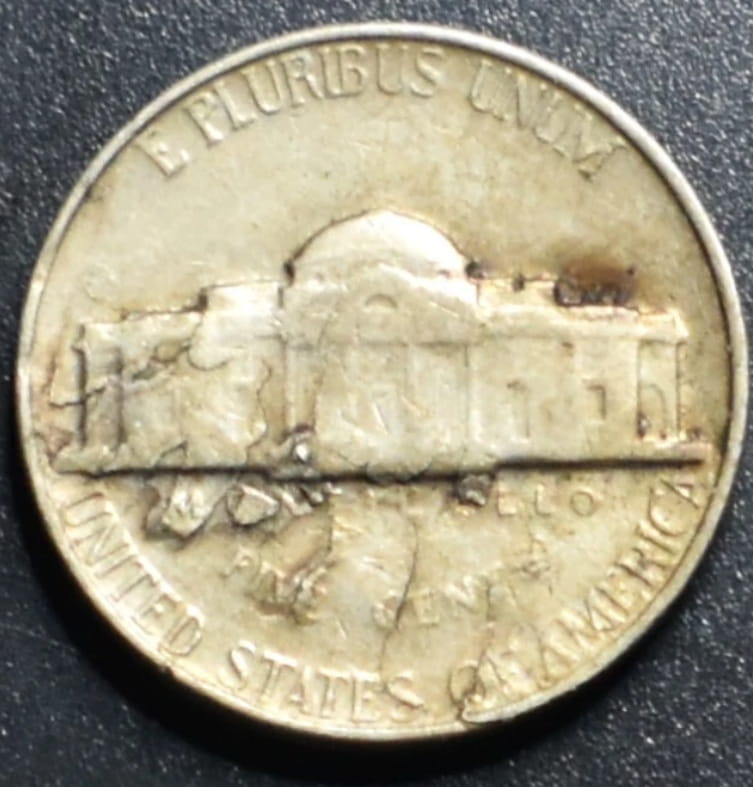
1964 Jefferson nickel lamination error — surface shows flaking, peeling, or separated metal layers from impurities in the alloy during planchet preparation.
Lamination errors result from impurities or improper mixing in the copper-nickel alloy during planchet preparation. The coin surface develops cracks, peeling, or separated layers — appearing as raised blisters, flaking metal, or patches where the surface layer has partially or fully separated. Minor surface laminations bring $8–$25; major peeling or missing layers fetch $40–$100. Laminations on the face (obverse or reverse fields) are more valuable than edge laminations.
How to Identify:
Look for flaky or peeling metal patches, raised blisters, or areas where the surface layer appears to have separated from the coin body. Check the edges for visible layer separation. Genuine laminations will have a characteristic flaky texture. Must be distinguished from post-mint corrosion or chemical damage, which shows irregular pitting rather than the layered separation of true lamination errors.
Error #10 — Weak Strike
Insufficient die pressure — flat, mushy design details on high-relief areas
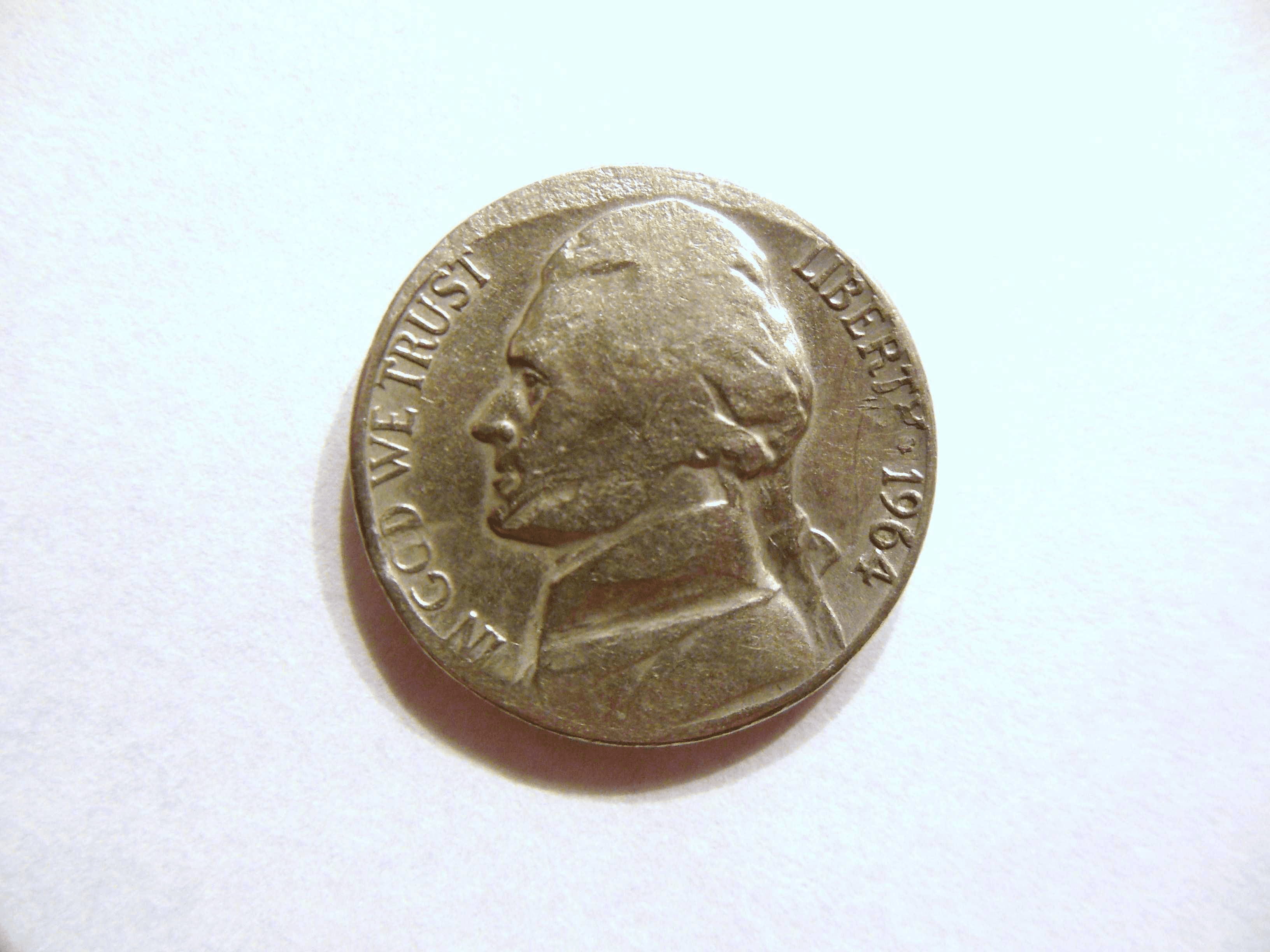
1964 Jefferson nickel weak strike — high-relief areas like Jefferson's hair, Monticello's steps, and lettering appear flat and softly defined.
Weak strike errors happen when insufficient pressure is applied during the striking process. The result is a coin with flat, mushy details on high-relief areas — particularly Jefferson's hair, Monticello's architectural steps, and peripheral lettering. Weak strikes were common during 1964's emergency production run as worn dies operated under varying pressure. Note: weak strike is distinct from Full Steps — a weak strike affects overall detail, while FS specifically describes complete step visibility.
How to Identify:
Examine the highest-relief design areas — Jefferson's hair above his ear and the steps of Monticello. On a weak strike, these areas appear flat and poorly defined even on an otherwise uncirculated coin. Must be carefully distinguished from post-mint wear: weak strikes show consistent softness across all high points, while wear shows directional flatness primarily on the highest points from contact.
Recent 1964 Jefferson Nickel Auction Results
What collectors are actually paying — Heritage, Stack's Bowers, PCGS
Table 6: Notable 1964 Jefferson Nickel Auction Records
| Coin | Grade | Sale Price | Year |
|---|---|---|---|
| 1964 SMS (Special Mint Set) | SP68FS | $32,900 | 2016 |
| 1964 SMS (Special Mint Set) | SP67FS | $22,800 | Recent |
| 1964-D D/D RPM FS-501 | MS66 | $19,800 | Recent |
| 1964-D D/D RPM FS-501 | MS65+ | $9,000 | Recent |
| 1964-P | MS67FS (Full Steps) | $14,100 | 2014 |
| 1964 Proof | PR67 DCAM | ~$2,750 | Recent |
| 1964-P Narrow Rim | MS67 | $200–$500 | Various |
| Wrong Planchet (dime blank) | VF Details | $300–$646 | 2005–2016 |
“The 1964 Jefferson nickel proves that common coins can hide extraordinary value. Two billion were made — but a Full Steps example or the D/D RPM FS-501 can turn a pocket-change nickel into a $20,000 coin. The steps on Monticello are the first thing to check.”
Best Coin Identifier App for 1964 Jefferson Nickels
Instantly identify Full Steps, D/D RPM, SMS specimens, and all error types
The 1964 Jefferson nickel presents specific identification challenges: Full Steps vs weak steps requires careful magnified examination; the D/D RPM FS-501 needs loupe comparison against reference images; and an SMS specimen can only be identified by its unusual satin surface quality. CoinKnow's coin identifier app includes dedicated tools for all of these challenges.
CoinKnow — Coin Identifier
iOS & Android · Identify Any Jefferson Nickel Variety in Seconds
Full Steps Detection
Side-by-side step comparison tools — annotated close-up images showing exactly how to count and evaluate the 5 or 6 Monticello steps for Full Steps designation on 1964 nickels.
RPM & Error ID
High-resolution D/D RPM FS-501 reference comparisons, DDO/DDR variety databases, wrong planchet weight guides, and error identification for all 10 documented 1964 nickel error types.
Live Market Values
Real-time pricing from Heritage, Stack's Bowers, and eBay sold listings — covering all varieties from common circulated strikes to SMS specimens and top-pop Full Steps coins.
Download CoinKnow Free — Available on Both Platforms


📱 Pro Workflow: CoinKnow + Expert Grading
- Step 1: Check the mint mark on the reverse, right of Monticello — none = Philadelphia, D = Denver.
- Step 2: If 1964-D, examine the “D” mintmark under 10× loupe — check for D/D RPM (second offset D impression).
- Step 3: Examine Monticello's steps under magnification — count 5 or 6 distinct, separated steps. Full Steps = major premium.
- Step 4: Weigh it — 5.0g = normal. Significantly different = potential wrong planchet error worth hundreds to thousands.
- Step 5: Use CoinKnow to photograph and compare against reference images for Full Steps and RPM confirmation.
- Step 6: Examine LIBERTY and the date under 10× magnification for doubling (DDO).
- Step 7: For any coin potentially worth $200+, submit to PCGS or NGC for Full Steps designation and grading.
The Bottom Line: Your 1964 Nickel Action Plan
What to do with every 1964 Jefferson nickel you find
Final Reality Check — 1964 Jefferson Nickel
| If Your Coin Has… | It's Probably Worth… | Your Next Step |
|---|---|---|
| Circulated, flat steps | $0.05 | Spend it — face value only |
| Uncirculated, no Full Steps, MS60–64 | $0.25–$15 | Store in a coin flip |
| Uncirculated, full steps visible | $65–$5,000+ | Submit to PCGS/NGC for FS designation |
| 1964-D with offset D mintmark | $5–$19,800 | Confirm FS-501 variety, then grade |
| Satin/frosty surfaces, razor detail | $1,000–$32,900 | SMS specimen — submit immediately |
| Mirror proof surfaces | $5–$2,750 | Grade if PR67+ or has Full Steps |
| Wrong weight (not 5.0g) | $300–$10,000+ | STOP — wrong planchet. Authenticate now. |
| Doubling on LIBERTY or date | $50–$500+ | Confirm DDO variety, authenticate if $200+ |
Your 5-Minute 1964 Nickel Checklist:
- Check the mint mark — right of Monticello on reverse. No mark = Philadelphia. D = Denver (check for RPM).
- Full Steps test — use a loupe and count the steps at Monticello's base. 5 or 6 distinct separated steps = Full Steps designation = significant premium.
- RPM check (1964-D only) — examine the “D” mintmark under 10× magnification for a second offset “D” impression. The FS-501 variety is worth up to $19,800.
- Weigh it — 5.0 grams is correct. Any significant deviation = potential wrong planchet error worth hundreds or thousands.
- Surface quality — mirror = proof. Satin/frosty with razor detail = possible SMS specimen worth $1,000+.
- Error scan — check for LIBERTY doubling (DDO), off-center design, missing rim (broadstrike), or arc-shaped missing edge (clipped planchet).
- Use CoinKnow — instant Full Steps comparison, RPM identification, and current market values from your phone.
The 1964 Jefferson Nickel: Common Coin, Hidden Treasure
In 1964, as America faced one of its worst coin shortages in decades, the U.S. Mint went into overdrive. Billions of Jefferson nickels rolled off the presses in Philadelphia and Denver — so many that the “1964” date was frozen and used well into 1966. The coins flooded circulation, ended up in jars, drawers, and piggy banks across the country, and were largely forgotten as just another common five-cent piece.
But within those billions of ordinary nickels were a handful of extraordinary ones: Full Steps coins struck from fresh dies at the exact right pressure, D/D Repunched Mintmarks with offset impressions that now fetch nearly $20,000, SMS specimens with satin finishes that no one at the time knew were rare, and a catalog of striking errors that escaped quality control during the rushed production run.
“Two billion 1964 nickels were made in three years of emergency production. That's exactly why finding a Full Steps example or the FS-501 RPM is so rewarding — they were never supposed to be rare, but they are. Monticello's steps are five cents away from a real discovery.”
Check every 1964 nickel you find. The loupe is cheap. The Full Steps test takes thirty seconds. The difference between a flat-step coin worth five cents and a Full Steps MS67 coin worth $14,000 is visible right there at Monticello's front door.
Found a 1964 Nickel Worth Investigating?
Use CoinKnow for instant Full Steps identification and error detection, then send anything potentially valuable to PCGS or NGC for professional grading.
Last updated: 2026 | Values based on Greysheet CPG®, PCGS CoinFacts, NGC Price Guide, Heritage Auctions, and eBay sold listings
Disclaimer: Coin values are estimates based on recent market data. Actual prices depend on individual coin condition, current demand, and auction timing. Professional grading recommended for coins potentially worth $200+.